Why ICHRA + FSA/HRA Is the Winning Benefits Architecture for 2026
Why ICHRA + FSA/HRA Is the Winning Benefits Architecture for 2026
Why ICHRA + FSA/HRA Is the Architecture That Wins in 2026
Table of Contents
Definition
Analogy Quote
Video
Historical Story
Bridge Paragraph
Modern Explanation
The Modular Benefits Architecture Framework
Contrarian Insight
Action Steps
FAQs
Call to Action
Sources
Definition
ICHRA combined with FSA and HRA creates a consumer-directed health (CDH) architecture where employers control costs, employees gain choice, and compliance is modular rather than monolithic. This structure separates insurance selection from benefit funding—unlocking flexibility, scalability, and long-term sustainability.
Analogy Quote
The strongest systems are built in layers, not blocks.
Historical Story
In the early 2000s, software companies faced a scaling crisis. Monolithic applications—massive, all-in-one systems—were expensive, slow, and fragile. A single failure could crash the entire operation.
Then architecture changed.
Tech leaders moved to modular stacks: independent services, flexible layers, and APIs that allowed systems to evolve without total rewrites. Innovation accelerated. Costs stabilized. Resilience improved.
Health benefits are undergoing the same shift.
Traditional group health plans are monolithic—one carrier, one design, one failure point. ICHRA didn’t just introduce a new funding method. It introduced architectural separation. Adding FSA and HRA completes that transformation.
Bridge Paragraph
ICHRA alone gives employees choice. FSAs and HRAs give them precision. Together, they form a benefits architecture that mirrors modern financial systems—flexible, personalized, and resilient. This is not a trend. It’s an infrastructure shift.
Modern Explanation
ICHRA covers premiums and eligible medical expenses tied to individual insurance. FSAs and HRAs extend that value by addressing out-of-pocket costs, predictable care, and employer-specific strategies.
For example, an employer may use ICHRA for insurance premiums, a limited-purpose FSA for dental and vision, and a post-deductible HRA for high-cost claims. Each tool serves a distinct role, governed by its own rules—but administered through one system.
Without integration, this complexity collapses. With modern CDH administration, it becomes a competitive advantage. Employers gain budget control. Employees gain clarity. Brokers gain a differentiated strategy.
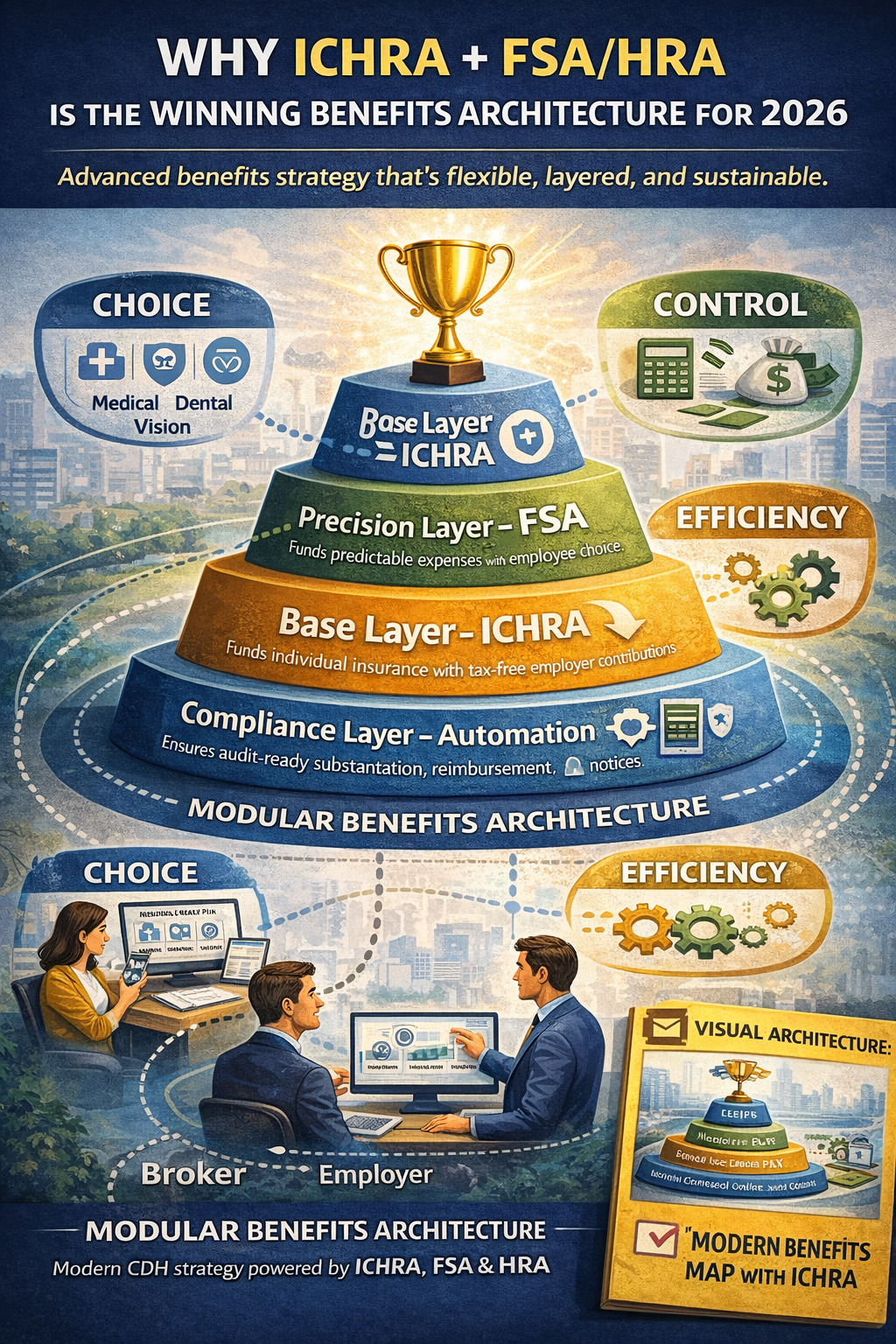
The Modular Benefits Architecture Framework
The Modular Benefits Architecture Framework aligns CDH tools into one coherent system:
Base Layer – ICHRA
Funds individual insurance with defined employer contributions.Precision Layer – FSA
Handles predictable, tax-advantaged expenses with employee choice.Risk Layer – HRA
Protects against high-cost or strategic expenses.Compliance Layer – Automation
Ensures substantiation, notices, and documentation are always audit-ready.Experience Layer – Communication
One interface, one language, one employee journey.
Contrarian Insight
Most employers believe adding FSA or HRA increases complexity, but the truth is modular benefits reduce risk when administered correctly.
Complexity doesn’t come from tools—it comes from disconnected systems. Architecture is what turns parts into performance.
Action Steps
Audit your current benefits for overlap, gaps, and rigidity.
Redesign benefits as layers, not packages.
Align brokers, TPAs, and payroll under one CDH strategy.
Educate employees using architecture-based visuals.
Partner with CaféHealth to deliver integrated ICHRA, FSA, and HRA administration with AI-powered compliance.
📥 Lead Magnet: Download the visual architecture — “Modern Benefits Map with ICHRA” — and see how today’s best employers design benefits.
FAQs
Why is ICHRA + FSA/HRA the winning architecture for 2026?
Because it separates insurance choice from benefit funding while maximizing tax efficiency and flexibility.
Can ICHRA work without FSAs or HRAs?
Yes, but layering CDH tools increases precision and employee value.
Does this increase compliance risk?
Not when administered through an integrated platform.
Is this model only for large employers?
No. Automation makes it scalable for small and mid-sized organizations.
How do employees experience this structure?
As clearer choices, better communication, and fewer surprises.
Do brokers benefit from this architecture?
Yes—it's a differentiated, future-proof strategy.
Call to Action
Call to Action
“See how CaféHealth improves accuracy, compliance, and employee experience with AI-powered benefits administration. Start here: CafeHealth.com.”