
What Is ICHRA? The Complete Guide to Individual Coverage HRAs
The traditional group health model is breaking under rising costs. Every year, businesses face the same impossible choice: absorb another double-digit premium increase, or pass the burden onto employees. This guide explains the alternative reshaping that decision — what an ICHRA actually is, how it works, and what the real numbers look like.
Why group health plans are breaking
For decades, employer-sponsored health insurance ran on a simple promise: offer a solid group plan, share the cost with employees, and everyone wins. That promise is getting harder to keep. Annual renewals with 15–20%+ increases are becoming common, not exceptional — and smaller groups get hit hardest, since a single serious claim can swing an entire renewal for a risk pool that's too small to absorb it.
This is the defined-benefit dilemma: an employer promises a specific insurance product, priced by someone else, with risk it doesn't control. The company carries the political and financial weight of that decision every twelve months, with almost no levers to manage the outcome. Doing nothing about it isn't actually a neutral choice — if the status quo is already unsustainable, staying on it is its own expensive strategy.
A 10–12% annual renewal increase compounds to a 30–40% cost increase within three years — before any headcount growth is factored in.
What is an ICHRA?
An Individual Coverage Health Reimbursement Arrangement (ICHRA) is an employer-funded benefit that reimburses employees for individual health insurance premiums — and optionally, qualified medical expenses — instead of the employer buying and administering a traditional group health plan.
The core shift is simple to state and significant in practice: instead of promising a specific plan, the employer sets a defined contribution — a fixed monthly budget per employee — and lets each person choose an individual-market plan that actually fits their needs. Regulations finalized in 2020 opened this model to employers of any size, in a fully compliant way.
How does ICHRA actually work?
There are three moving parts. First, the employer defines employee classes — full-time, part-time, salaried, hourly, seasonal, or geographic groupings, using categories the IRS permits, not arbitrary labels like job titles. Second, the employer sets a contribution amount per class, usually benchmarked against the lowest-cost silver plan available in that area. Third, each employee uses that allowance to buy an individual health plan on the ACA marketplace or off it, and gets reimbursed up to their monthly allowance.
Because the employer is no longer insuring claims directly, the financial exposure is bound by the allowance design, not by what happens to sit in the risk pool that year. In practice, many organizations that calibrate allowances carefully see 20–30% savings compared to their prior group plan, even after accounting for administration fees.
ICHRA vs. traditional group health insurance
In a traditional group plan, the employer chooses one or a few plans, takes on claims and renewal risk directly, and every employee enrolls in (or waives) those specific plans. Costs are tied to the group's own claims performance — volatile, especially for smaller groups. An ICHRA moves that risk to the broader individual market instead.
A real case: RFK Community Alliance
In 2024, RFK Community Alliance stood at a breaking point. Their group health plan was set to renew with yet another crushing double-digit increase — the options were grim: cut programs, freeze hiring, or shift more cost onto employees already stretched thin. Instead, they moved to an ICHRA. One year later, they had stabilized their benefits budget, given employees more choice and control over their coverage, and saved a significant amount of money in the process.
RFK Community Alliance, year one
This is the case study The ICHRA Revolution is built around — the same story behind the "$1.4 million question" that opens the book.
Who is eligible for an ICHRA?
Employers can offer an ICHRA to almost any W-2 employee group, defined using IRS-permitted classes — full-time, part-time, seasonal, salaried, hourly, or geographic region among them. To actually receive reimbursements, employees must be enrolled in a qualifying individual health plan that provides Minimum Essential Coverage. A couple of common exclusions are worth knowing up front: 2% S-corp owners aren't eligible to participate under IRS attribution rules, and plans that don't count as Minimum Essential Coverage — Health Care Sharing Ministries and short-term "Freedom Plans" among them — can't be reimbursed through an ICHRA.
One population that's often overlooked: Medicare-eligible active employees are frequently excellent ICHRA candidates, since their premiums are usually lower than ACA marketplace premiums for equivalent coverage.
ICHRA and ACA affordability
For Applicable Large Employers, the ICHRA offer has to be "affordable" under the ACA, or the employer risks an Employer Shared Responsibility Payment. The threshold isn't fixed — it changes almost every year, so a calculation from two years ago doesn't carry over.
| Tax year | Affordability percentage |
|---|---|
| 2023 | 9.12% |
| 2024 | 8.39% |
| 2025 | 9.02% |
| 2026 | 9.96% |
The test itself runs in three steps: pick an IRS-approved safe harbor (commonly Rate of Pay, W-2, or Federal Poverty Line), multiply the employee's safe-harbor income by that year's percentage, then compare the result to the employee's monthly cost for the lowest-cost silver plan after the ICHRA contribution is applied. This is calculated employee by employee, not class by class — two people in the same class, at different ages or pay rates, can land on opposite sides of the affordability line.
Common ICHRA objections, answered
"Our employees won't have good plan options." This is a real risk in some rural markets, not a myth — but it's checkable. Before committing to ICHRA, map where employees actually live and evaluate carrier participation, plan diversity, and premiums in each area. Some organizations pilot ICHRA in strong markets first rather than rolling it out everywhere at once.
"This is too complex to administer correctly." The complexity is real but manageable with the right structure — correctly defined employee classes, a disciplined monthly substantiation process, and a technology partner who handles the affordability recalculation every year rather than reusing last year's numbers.
"We'll lose control over what employees are covered for." In practice, employers report the opposite: fixed contributions create more budget control, not less — the variable that used to be uncontrollable (claims-driven renewals) is replaced by a number the employer sets in advance.
Is ICHRA right for your organization?
Four questions worth answering honestly before moving forward:
Frequently asked questions about ICHRA
What is an ICHRA and how does it work?
How is an ICHRA different from a traditional group health plan?
What are the main advantages of an ICHRA for employers?
What are the main advantages for employees?
Who is eligible to participate in an ICHRA?
How does ICHRA affect ACA affordability and premium tax credits?
Can Medicare-eligible employees participate in an ICHRA?
Can employers offer ICHRA to part-time or seasonal employees?
What are the main steps to implement an ICHRA, and how long does it take?
Brooks Knoll, HSAe
Get the full book
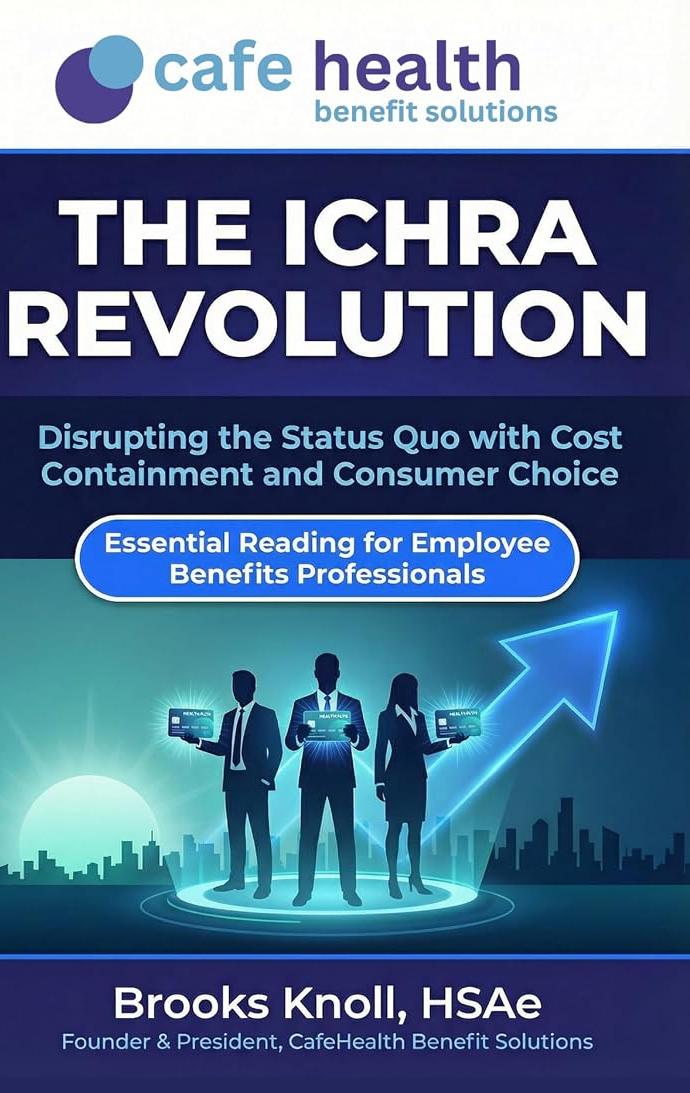
Everything in this guide is covered in far more depth in The ICHRA Revolution — the full financial model, the compliance chapter, employee-class design, and the real 90-day rollout blueprint, all built around the RFK Community Alliance case study.
Prefer the PDF? Get the free digital edition here.
Ready to see if ICHRA fits your organization?
Read the full book, or talk it through with Shannon first.
Need Assistance?
Effortlessly submit a service ticket directly through our platform. Our dedicated team is ready to tackle your queries and ensure a swift resolution. Ideal for clients, participants, and brokers seeking prompt support

Copyright 2026. All Right are Reserved. CafeHealth, LLC.